
Self Assessment Student Loan Repayment: Everything UK Borrowers Need to Know
You got a letter from HMRC. Or maybe you just filed your first tax return as a freelancer and noticed a student loan section you were not expecting. Either way, you are now wondering whether you owe more money on top of what your employer already takes, how HMRC even knows about your loan, and what happens if you get it wrong.
These are completely reasonable things to worry about. Student loan repayment and self-assessment sitting in the same tax return confuses a lot of people, particularly those who are both employed and doing freelance work on the side. The numbers feel unclear, the deadlines sneak up, and overpaying is easier to do than most people realise.
Our student loan repayment calculator on this site takes the guesswork out of it. But before you run your numbers, this guide explains how the whole system works, what counts as income, how your employer’s deductions interact with your tax return, and what to do when your loan is almost gone.
Does having a Student Loan Automatically Mean You Need to do a self-assessment?
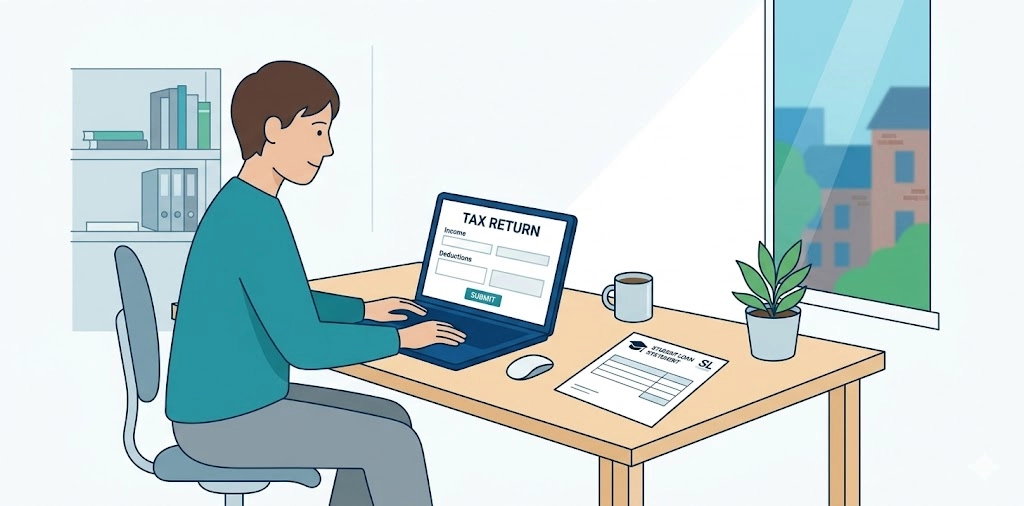
No. This is one of the most common misconceptions going. Your student loan and self-assessment are connected, but your loan is not the reason you need to complete a tax return.
You register for self-assessment because of your tax situation: self-employment income, rental income, earnings above £100,000, dividends outside your allowance, or other untaxed income. Once HMRC pulls you into the self-assessment system for any of those reasons, your student loan repayment calculation happens as part of the same return.
So if you are purely employed, your employer handles everything through PAYE, and you never touch a tax return for student loan purposes. The moment you have income outside of PAYE, that changes.
How the Self Assessment Student Loan Calculation Works
Self-assessment student loan repayments follow a straightforward formula once you know your numbers.
- Add up your total gross income for the year
- Subtract your plan threshold
- Multiply the difference by your repayment rate
Worked example for a Plan 2 borrower:
Gross self-employment income: £38,000 Plan 2 threshold: £28,470 Difference: £9,530 Repayment rate: 9% Student loan repayment due: £857.70
That figure then gets reduced by whatever your employer already took through PAYE if you were also employed during the year. More on that shortly.
This matters more than most guides admit. Your total income figure includes:
- Self-employment profits (after allowable expenses, before tax)
- Employment salary (your gross pay, not take-home)
- Dividends received
- Rental profits after the property allowance
- Savings interest, but only if it exceeds £2,000 in the year
The savings interest rule is worth pausing on because it catches people off guard. If you earned exactly £2,000 in savings interest, none of it counts toward your student loan calculation. But if you earned £2,001, the entire £2,001 gets counted. Not just the £1 above the limit. All of it. HMRC calls this the all-or-nothing rule, and it applies regardless of your personal savings allowance.
This matters because someone saving aggressively while self-employed could tip over the £2,000 mark and suddenly owe an extra £180 in student loan repayments on income they may not have even spent.
Check your current student loan repayment interest rates on our dedicated page so you understand how interest stacks up on your outstanding balance at the same time.
Ensure you know exactly how much principal you have left by reading how to check your student loan balance before filing your tax return.
Budget Payment Plans: Spreading Your Bill Without Reducing Your Loan Interest
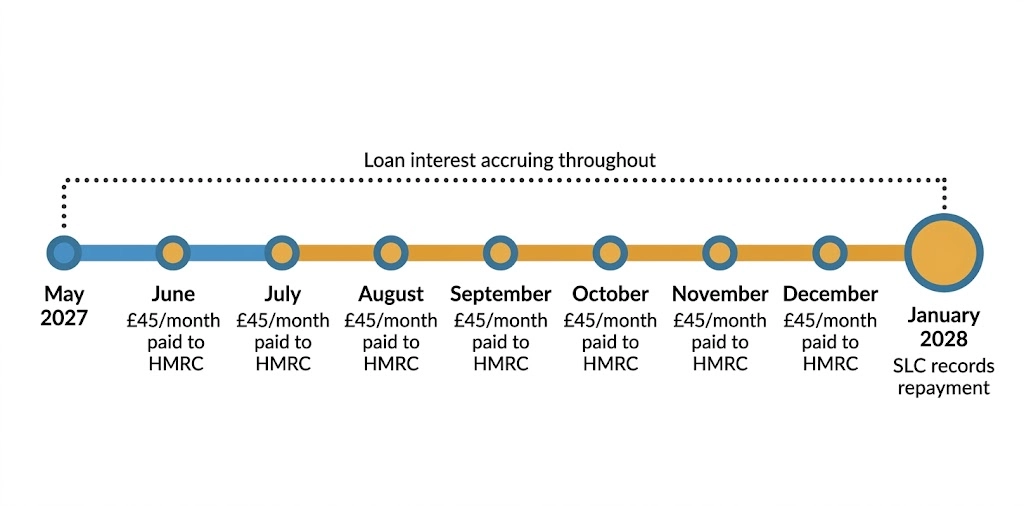
HMRC offers a direct debit budget payment plan where you pay your self-assessment bill in monthly instalments rather than as a lump sum in January. Student loan repayments are included in this arrangement.
The drawback for student loan borrowers specifically is this: even though HMRC holds your money early, your loan interest keeps accruing against the full outstanding balance until 31 January. Paying early through the budget plan does not reduce the interest building up on your SLC account.
Dealing With Late Payments and Managing Student Loan Arrears
Because self-assessment tax loans sit within your overall self-assessment bill, missing the 31 January deadline means interest and penalties apply to everything together, student loan repayment included. HMRC does not treat the student loan portion more leniently than the rest.
Managing student loan arrears through the self-assessment route is handled via HMRC’s Time to Pay service. If you cannot pay your bill in full, contact HMRC before the deadline. They can set up an instalment arrangement covering your whole bill. You need to have filed your return first before calling.
Once your repayment is processed, HMRC passes the details to the SLC, and they update your loan balance accordingly. SLC does not chase you directly for self-assessment amounts. That is HMRC’s responsibility.
Making Tax Digital and Student Loans
If you have been pulled into Making Tax Digital for income tax, the student loan repayment process works the same way, just through MTD-compatible software rather than the standard return.
Your student loan plan type and repayment information should be pre-populated as part of the end-of-year process in your software. Check it carefully. If anything looks wrong, contact HMRC before you submit.
Student loan repayments are not tax-deductible under MTD end-of-year returns either. The same 31 January payment deadline applies.
Which Repayment Plan Are You On?
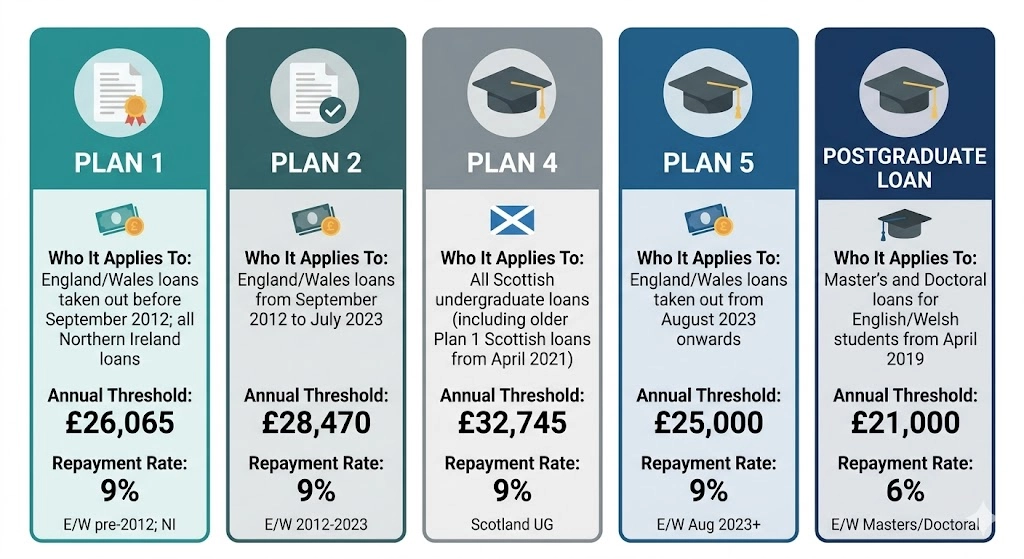
Your plan determines your repayment threshold and your repayment rate. Get this wrong, and your self-assessment student loan calculation will be off from the start.
Here is how the plans break down for 2026/27:
Plan | Who It Applies To | Annual Threshold | Repayment Rate |
Plan 1 | England/Wales loans taken out before September 2012; all Northern Ireland loans | £26,065 | 9% |
Plan 2 | England/Wales loans from September 2012 to July 2023 | £28,470 | 9% |
Plan 4 | All Scottish undergraduate loans (including older Plan 1 Scottish loans from April 2021) | £32,745 | 9% |
Plan 5 | England/Wales loans taken out from August 2023 onwards | £25,000 | 9% |
Postgraduate Loan | Master’s and Doctoral loans for English/Welsh students from April 2019 | £21,000 | 6% |
If you are unsure which plan you are on, check your original loan documents or log into your Student Loans Company account. Northern Ireland borrowers are always on Plan 1. Scottish borrowers moved to Plan 4 rules in April 2021, even if their loan originally started under Plan 1.
You can find out more about how different plans interact on our repaying more than one student loan page, which covers borrowers holding both an undergraduate and a postgraduate loan at the same time.
If you have missed previous tax payments and fallen behind, review your options for managing student loan arrears.
Income-Contingent Student Loans: What This Actually Means
The phrase income contingent student loan self-assessment sounds technical, but the concept is simple. All current UK undergraduate plans (1, 2, 4 and 5) are income-contingent. That means your repayments go up when your income rises and fall when it drops. When your income falls below the threshold, repayments stop completely. There is no fixed monthly payment, and you cannot fall into arrears in the way you can with a bank loan.
This is fundamentally different from a commercial loan. You do not owe a set amount per month. You owe a percentage of whatever you earn above a certain figure. Under self-assessment, that calculation happens once a year across your total income from all sources.
Understanding this helps you see why the self-assessment tax return student loan section exists. The system needs to see your full picture once a year to catch any income that PAYE missed.
Our terms and conditions guide explains the write-off rules and what happens to remaining balances after the repayment period ends.
Voluntary Repayments and What They Mean for Your Tax Return
You can pay the Student Loans Company directly at any time. There is no penalty for early repayment. But voluntary payments made directly to the SLC do not reduce your self-assessment liability.
This trips people up. If you pay £500 directly to your SLC account in September, you still owe the full amount calculated by your self-assessment return in January. The voluntary payment does not count.
The only payments that count as a credit against your self-assessment bill are PAYE deductions made by your employer.
One exception: if you have been working abroad and making direct repayments, then return to the UK tax system and complete a self-assessment return, HMRC calculates your liability without accounting for those overseas payments. Our living overseas with student loan page covers that scenario in full.
If you are registered as self-employed but live outside the UK, you must follow specific rules for overseas student loan repayment.
How to Calculate Your Self-Assessment Student Loan Repayment
Use this as a quick checklist before you sit down with your return.
Step 1
Confirm your loan plan (Plan 1, 2, 4, 5 or Postgraduate)
Step 2
Add up all income sources: employment salary, self-employment profits, dividends, rental profits, savings interest above £2,000
Step 3
Subtract your plan threshold from total income
Step 4
Multiply the result by 9% (Plans 1, 2, 4, 5) or 6% (Postgraduate)
Step 5
Subtract any PAYE student loan deductions already made by your employer(s) during the year
Step 6
The remaining figure is what you owe via self-assessment
Learn how your Self Assessment handles multiple simultaneous deductions by reading about repaying more than one student loan.
Key Deadlines for Self-Assessment Student Loan Repayments in 2026
Student loan self-assessment payments follow the same calendar as the rest of your self-assessment bill.
Tax Year | Paper Return Deadline | Online Return Deadline | Payment Deadline |
2025/26 | 31 October 2026 | 31 January 2027 | 31 January 2027 |
2026/27 | 31 October 2027 | 31 January 2028 | 31 January 2028 |
Two things worth knowing about these dates:
Student loan repayments are not part of Payments on Account. When HMRC asks you to pay 50% of last year’s bill upfront in January and July, that only covers income tax and Class 4 NIC. Your student loan portion is always a balancing payment due on 31 January.
Paper return before 31 October means HMRC does the calculation. If you file your paper return before 31 October, HMRC will work out your student loan repayment for you. Miss that date, and you calculate it yourself or use an accountant. Online filers always calculate at the time of filing, with HMRC’s software doing the arithmetic in real time.
Late payment of the self-assessment bill attracts interest and penalties, and your student loan portion is included in that. HMRC does not treat it separately.
If You Are Both Employed and Self-Employed
This is where most people get confused. And it is where both the financial stakes and the potential for overpaying are highest. So this section goes into real detail.
Employee student loan repayment is automatic. Your employer gets notified to start making deductions, either when you start a job and provide your P45, or through a start notice from HMRC. The deduction shows up on your payslip each month.
Your P60 at the end of the tax year shows the total amount deducted by that employer. Keep your payslips throughout the year. If you change jobs, your P45 does not carry a running total of deductions made at your old job. Your new employer’s P60 only shows what they took. You have to manually add up your old payslips to get the full picture for your tax return.
Example of tracking deductions across two jobs:
Say you changed jobs in August 2026. Your old employer deducted:
- April: £32
- May: £29
- June: £29
- July: £31
Your new employer’s P60 for 2026/27 shows £248.
Total PAYE student loan deductions for the year: £32 + £29 + £29 + £31 + £248 = £369
That £369 goes on your self assessment return. HMRC credits it against your total calculated repayment. You only pay the shortfall, not the full amount again.
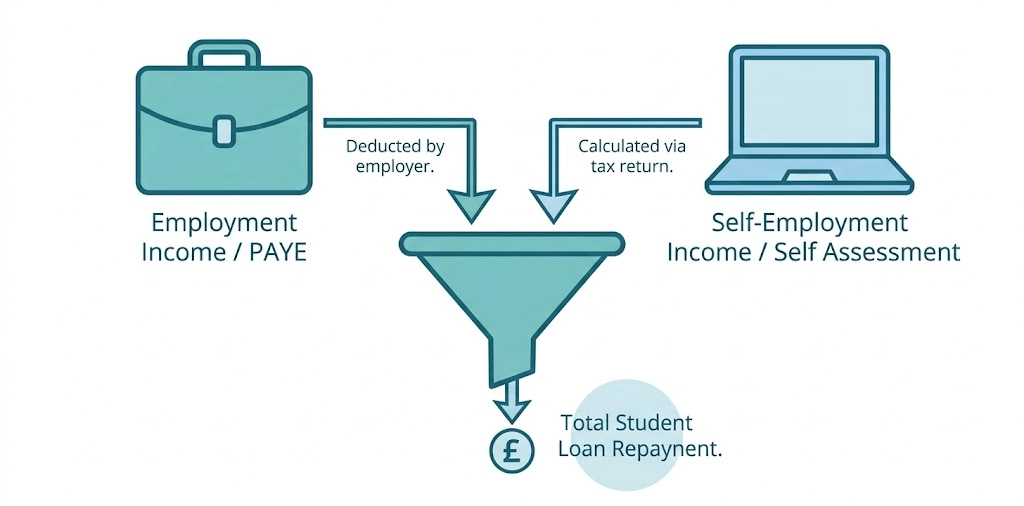
Here is the key point people miss. If you earn £32,000 from your job and £12,000 from freelance work, HMRC calculates your annual repayment on the combined £44,000, not just the self-employment part.
Your employer has already deducted based on your salary alone. That left the freelance income untouched. Your self-assessment return catches that gap and charges you 9% of whatever additional income sits above your threshold.
Employment income: £32,000 Self-employment income: £10,000 Total income: £42,000 Plan 2 threshold: £28,470 Income above threshold: £13,530 9% of £13,530 = £1,217.70 total repayment due
PAYE deductions already made: £320 (based on salary alone). Remaining liability via self-assessment: £897.70
Without the self-assessment return, that £897.70 would never have been collected. HMRC knows this, and it is why HMRC self-assessment student loan requirements exist for anyone with mixed income.
You need to enter:
- Your total student loan repayment self-assessment figure owed for the year (HMRC calculates this from your income)
- The total PAYE deductions already made by your employer(s)
HMRC pre-populates the PAYE figure from employer data. Always check it against your own records. If it is wrong, you can override it. Just explain the discrepancy in the additional information box.
Understand how the strict £21,000 threshold affects your overall tax bill in our guide to postgraduate loan repayment.
Frequently Asked Questions
Does having a student loan mean I have to do a self-assessment?
No. Your loan is not the reason to register for self-assessment. You register because of your income type (self-employment, rental, higher-rate earnings, etc.). Your loan is then calculated as part of your return.
How do I know which student loan plan I am on?
Your loan plan depends on where you studied and when. Check your SLC account or original loan documentation. Northern Ireland borrowers are always Plan 1. Scottish borrowers follow Plan 4 rules. England and Wales borrowers follow Plans 1, 2 or 5 depending on when they started their course.
My employer already deducts student loan payments. Do I pay again through self-assessment?
No, you do not pay twice. Your PAYE deductions are listed on your self-assessment return and credited against the total calculated repayment. You only pay the difference.
Are student loan repayments a tax-deductible expense?
No. You cannot deduct student loan repayments as a business expense or offset them against your tax liability. They are a separate obligation calculated on your income.
What happens if I overpay through self-assessment?
Any overpayment is applied against other outstanding tax or NIC liabilities first. If none exist, you can request a refund. Contact HMRC in writing to start that process.
What is the payment deadline for self-assessment student loan repayments?
The same as the rest of your self-assessment bill: 31 January following the end of the tax year. For 2025/26, that is 31 January 2027.
What is an income-contingent student loan?
It means your repayments are based on what you earn, not a fixed monthly amount. All current UK undergraduate plans are income-contingent. Repayments stop automatically when your income drops below the threshold and start again when it rises above it.
What if my loan is fully paid off before I file my return?
If you cleared the balance between the tax year end (5 April) and your filing date, remove the student loan entries from your return and explain this in the additional information box. HMRC will confirm with SLC. Do not overpay when the balance is already gone.

