
Repaying Your UK Student Loan When You Live Overseas
You moved abroad. Maybe for work, a relationship, or just a fresh start somewhere new. And somewhere in the back of your mind, there’s that nagging question: What happens to my UK student loan now?
A lot of people assume it pauses. Or that the Student Loans Company somehow won’t notice. Some people genuinely don’t know they’re still supposed to be paying. And some have been ignoring letters for years, hoping it goes away. It doesn’t go away.
But it’s also not as complicated as it feels. Once you understand how overseas repayment actually works, which plan you’re on, what threshold applies in your new country, and what you need to do every year, it becomes just another admin task. This guide covers all of it. Plans 1, 2, 4, 5, and the Postgraduate Loan. Real thresholds for 2026. Step-by-step what you actually need to do. And honest answers to what happens if things have gone wrong.
If you want to check your current balance, calculate what you owe, or compare repayment options, our student loan repayment calculator is a good place to start before you read further.

What to do before you leave?
- Contact the SLC online or by phone and confirm your departure date, destination country, and your overseas address
- Request the Overseas Income Assessment (OIA) pack
- Complete the OIA form with supporting income evidence; payslips, employment contract, or tax documents
- Confirm your account has been switched to overseas borrower status before your final UK payslip
Give yourself at least four to six weeks before departure to do this. If you try to rush it in the last few days, things don’t always process in time, and your final employer may still make a PAYE deduction on top of whatever the SLC arranges. Ignoring your debt while living abroad is a quick way to find yourself managing student loan arrears when you return to the UK.

How the Overseas Income Assessment Works
Once you’re registered as an overseas borrower, the system runs on an annual cycle. This replaces PAYE entirely. It puts the responsibility for accurate income reporting on you, not your employer.
Each year, the SLC sends you an Overseas Income Assessment form, by email if you’re registered online, or by post otherwise. The form asks for your total income in local currency for the previous assessment year. You send back supporting documents: payslips, a tax return from your new country, or a letter from your employer confirming salary. You normally have around two to three months to return everything.
Once they receive it, the SLC converts your gross annual salary to GBP using the exchange rate for your country, published annually by HMRC. They then deduct your country’s adjusted threshold and calculate 9% of what remains (or 6% if you’re on the Postgraduate Loan). That annual figure is split into 12 equal monthly payments.
You must actively log in and learn how to check your student loan balance since you will no longer receive standard UK mail effortlessly.
What happens if you miss the annual form?
If you ignore the OIA or return it more than three months late, the SLC doesn’t wait. They impose a fixed monthly repayment, the maximum band for your plan. That figure typically runs between £300 and £700 per month, depending on your plan and country, and it applies until you provide actual income evidence. If your real income is lower than the assumed figure, you can get a retrospective adjustment, but getting that sorted takes time and correspondence.
Which Loan Plan Are You On?
You need to know which plan applies to you. The thresholds, interest rates, and write-off timelines are different for each one. Getting this wrong means you could be overpaying or underpaying, both of which cause problems.
If you hold more than one type of loan, you’re repaying both at the same time once you cross the respective thresholds. Our guide on repaying more than one student loan explains exactly how that works when you’re overseas.
Plan 1
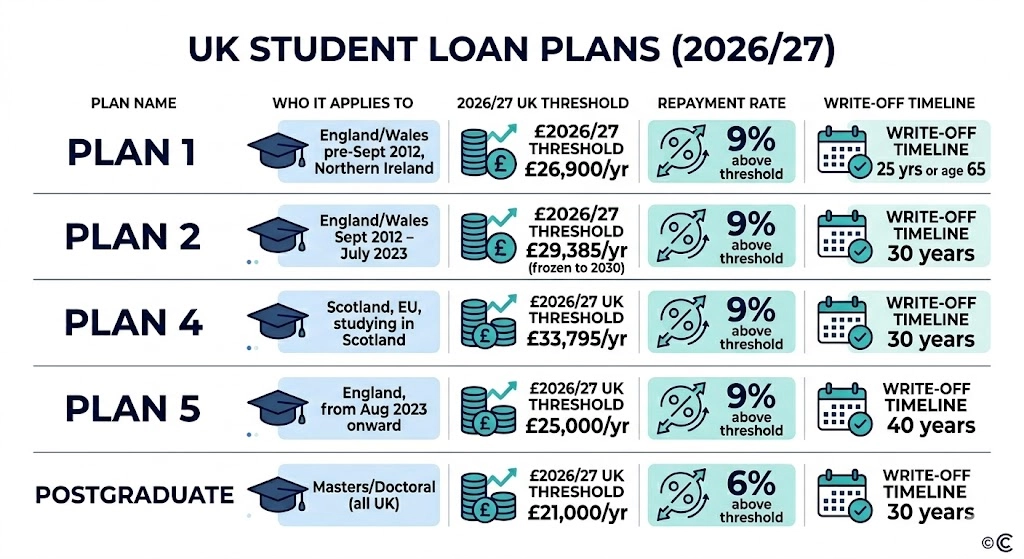
You’re on Plan 1 if you started an undergraduate course in England or Wales before September 2012, or if you studied in Northern Ireland at any point. The UK repayment threshold for 2026/27 is £26,900 per year. Interest sits at a flat 1.75%. The loan is written off after 25 years or when you turn 65, whichever comes first.
Plan 2
Plan 2 applies if Student Finance England funded your course between September 2012 and July 2023, or if Student Finance Wales funded you from September 2012 onward. The student loan overseas repayment threshold in the UK for 2026/27 is £29,385 per year, and that figure is frozen until April 2030. Interest runs between 4.3% and 7.3%, depending on your income. Write-off happens after 30 years.
Postgraduate Loan (Plan 3)
Postgraduate Loan borrowers repay 6% of income above £21,000 per year, not 9%. If you’re also repaying an undergraduate loan at the same time, you’re repaying more than two loans. The same overseas reporting process applies as the other plans. For more on how this stacks up, see our postgraduate loan guide.
Plan 4
Scottish students fall under Plan 4, along with EU students who studied in Scotland. The UK threshold is £33,795 per year in 2026/27. Interest rate: 1.75%. Write-off: 30 years.
Plan 5
If you started an undergraduate course in England from August 2023 onward, you’re on Plan 5. Repayments only started from April 2026 at the earliest. The UK threshold is £25,000 per year. Interest is charged at RPI only, currently 3.2%. Write-off doesn’t happen until 40 years in, which is longer than any other plan.
Repayment Thresholds and How They What Actually Changes When You Move Abroad What You Pay
This is where most people get confused. While you were in the UK and employed, your employer handled everything. Every month, PAYE took your student loan repayment straight from your salary before it even landed in your account. You probably barely noticed it.
When you move overseas, specifically, when you’ve been outside the UK for more than three months, HMRC exits the picture completely. They stop being involved in your student loan repayments. The Student Loans Company takes over, and it becomes your job to report what you earn. If you have a Plan 2 and a Master’s loan, the Student Loans Company provides specific rules for expats repaying more than one student loan.
There are three other things that change, and they matter:
Every country has its own adjusted threshold, based on local living costs. Depending on where you’ve moved, you might start repaying at a lower income level than you would have in the UK, or a higher one.
Overseas repayments are fixed monthly amounts paid directly to the SLC, typically in GBP by direct debit or bank transfer. No employer involvement. You have to set this up yourself.
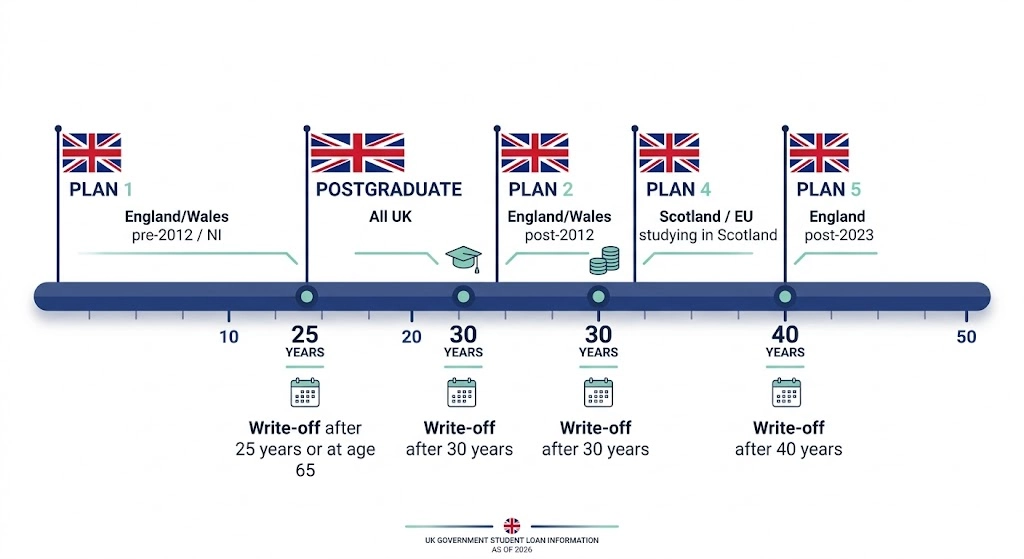
Moving abroad doesn’t pause, reset, or extend your write-off timeline. If you’re 10 years into a 30-year Plan 2 loan when you leave, you’ve got 20 years left, regardless of which country you’re in.
Does Moving Abroad Affect the Write-Off Date?
No, the write-off timeline for every plan runs from the date repayment was originally due, not from when you made your first payment. Moving abroad doesn’t pause it. Not making payments doesn’t pause it. The clock runs continuously, no matter what country you’re in.
When the write-off date arrives, the SLC automatically cancels any remaining balance on your account. You don’t need to apply or contact them. If your repayments were still running through PAYE when write-off happens, deductions stop, though it may take HMRC a month or two to update your tax code. If overpayments occur after write-off, you can reclaim them from the SLC.
The written-off amount is not treated as income. There’s no tax bill attached to it.
The 40-year write-off period for Plan 5 is worth particular attention for anyone under 25 right now. That timeline runs deep into your 60s for most current students. It’s a long period over which interest and income changes can significantly affect the total you end up repaying.
You Must Tell the SLC Before You Leave
This is the step most people skip, and it causes the most problems down the line.
The rule is simple: if you’re planning to leave the UK for more than three months, you must notify the Student Loans Company before you go. Not after you’ve arrived. Not once you’ve found a flat. Before you leave.
Failing to do this has real consequences. A penalty of up to £1,000 can be applied to your account. On top of the penalty, if you’re on Plan 2 and haven’t kept in touch, the SLC applies interest at RPI plus 3% regardless of your income level. That’s the maximum interest rate.
If you’re already abroad and haven’t told them yet, tell them now. Every additional month of delay adds to the arrears on your account. Our managing student loan arrears guide covers what to do if the balance has already grown beyond what you expected.
Interest Rates When You're Living Abroad
A lot of people assume moving overseas somehow affects their interest rate. It doesn’t, not in itself.
Plan 1 and Plan 4: Interest stays fixed at 1.75% wherever you live.
Plan 2: Interest runs between 4.3% and 7.3%, depending on income. The sliding scale works the same way overseas as it does in the UK;h the lower overseas threshold is treated as the starting point for the income-linked interest calculation. If your income sits below your country’s repayment threshold, interest is charged at RPI only.
Plan 5: Interest is charged at RPI only at all income levels, currently 3.2%. That’s simpler and more predictable than Plan 2.
Postgraduate Loan: The current rate is 7.3%.
Returning to the UK
When you come back for good the rules shift again. If you return for more than three months, you must tell the SLC. Your status reverts to UK taxpayer, PAYE deductions restart through your new employer, and any direct arrangement you had with the SLC as an overseas borrower needs to be cancelled.
If you don’t cancel it and you start a new UK job, you can end up with both PAYE deductions and ongoing direct debits running simultaneously. Sorting out double-payments takes time. If you return for less than three months, your overseas status continues. You don’t need to inform the SLC of a short visit.
Your Rights and Responsibilities as an Overseas Borrower
There’s a side of this that doesn’t get discussed much: what you’re actually entitled to, not just what you owe.
You have the right to see your full loan balance, repayment history, and the interest rate applied to your account at any time through your SLC online account. If the SLC has applied a fixed repayment due to a missed OIA and your actual income was lower than assumed, you’re entitled to a retrospective adjustment once you submit real income evidence. You can also check whether any overpayments have occurred and reclaim them.
Your responsibilities: keep your contact details current with the SLC at all times, submit the annual OIA on time with accurate income evidence, and notify them immediately when your income or employment situation changes, not at the next annual assessment. The terms and conditions guide on this site outlines the full framework of what the SLC can and can’t do.
How Overseas Repayment Thresholds Are Calculated
You probably assumed the threshold would be the same as in the UK. It isn’t. The SLC uses the World Bank’s Price Level Index (PLI) to adjust each country’s threshold relative to the UK. The UK itself has a PLI of 1.0. A country where everyday costs, housing, food, and transport run at 60% of UK levels gets a threshold that’s roughly 60% of the UK figure. That means you start repaying at a lower income, which can mean paying a larger percentage of your salary than you would have back home.
The flip side is also true. If you’ve moved somewhere with a higher cost of living than the UK, parts of Switzerland, Scandinavia, or the US, the threshold goes up. You start repaying later, and at the same 9% rate, you’ll pay less as a share of income.
Plan 2 Overseas Thresholds: Key Countries (2026/27)
Country | Currency | Lower Threshold (GBP) | Fixed Monthly Repayment |
USA | USD | £35,260 | £490.80 |
Australia | AUD | £29,385 | £409.00 |
Canada | CAD | £29,385 | £409.00 |
New Zealand | NZD | £29,385 | £409.00 |
Germany | EUR | £23,510 | £327.20 |
Spain | EUR | £23,510 | £327.20 |
France | EUR | £23,510 | £327.20 |
UAE | AED | £23,510 | £327.20 |
Switzerland | CHF | £35,260 | £490.80 |
Ireland | EUR | £23,510 | £327.20 |
What Happens If You Stop Paying
It’s worth being honest about this, because a lot of people end up in this situation, not out of bad faith, but because life abroad gets complicated and the paperwork slides.
The SLC cannot garnish wages from an overseas employer. Your foreign employer won’t make automatic deductions from your salary. Enforcing UK debt across international borders isn’t straightforward. Some people stop paying entirely, assuming it’s too difficult to collect.
The problem comes when you return to the UK. The moment you’re back in UK employment, PAYE restarts. But it doesn’t restart only on your ongoing obligation. You’ll also owe everything that accumulated while you were abroad,, unpaid repayments, plus interest on the full balance over that entire period.
It also affects your loan balance check. The balance doesn’t shrink while you’re not paying. It typically grows because interest accrues throughout. Use your student loan balance check to see exactly where you stand.
Frequently Asked Questions
Does my UK student loan follow me if I move abroad?
Yes. The loan stays on your account. The balance, plan type, interest rate, and write-off date remain unchanged. What changes is the repayment process, HMRC no longer handles deductions, and you report income directly to the SLC each year.
What is the Overseas Income Assessment?
It’s the annual income declaration that replaces PAYE deductions when you’re an overseas borrower. The SLC sends you a form each year asking for your income in local currency, along with supporting documents. They convert the figure to GBP and compare it to your country-specific threshold.
Will I pay more or less repaying my student loan from overseas?
It depends entirely on the country. High-cost destinations, the USA, Switzerland, Australia, have higher overseas thresholds. Lower-cost countries have lower thresholds and you start repaying sooner. Use our student loan repayment calculator to run your specific scenario.
What happens to my Plan 5 loan if I move abroad?
The same overseas assessment process applies. You notify the SLC, complete the annual OIA, and repay 9% of income above your country’s adjusted Plan 5 threshold. The interest rate remains RPI-only wherever you live.
How does student loan overseas repayment work if I'm self-employed?
You still complete the annual OIA. The SLC needs evidence of your self-employment income: tax returns from your new country, certified accounts, or bank statements showing income.
What is the student loan overseas repayment plan 2 threshold for popular countries?
The 2026/27 Plan 2 lower threshold is £29,385 for countries including Australia, Canada, and New Zealand. For EU countries including Germany, Spain, and France it drops to £23,510. For the USA it’s £35,260.
Can the SLC take legal action if I don't repay from abroad?
Yes, in some cases. The SLC is increasing overseas enforcement activity through 2026, including reporting to credit bureaus and pursuing legal action in countries where bilateral agreements or local courts allow it.
What if I have arrears from when I was living overseas?
Contact the SLC directly and request an arrears repayment arrangement. Submitting outstanding OIA forms for past years is the first step, this lets the SLC calculate what was actually owed versus what was assumed..
Do I need to update the SLC if my income changes mid-year?
Yes. You’re obligated to tell the SLC when your circumstances change, not just at the annual OIA. If you lose your job, change employers, or receive a significant pay increase, update them. Failing to report a major income change can mean incorrect repayments.

