
Pension vs Student Loan: Should You Pay Into Your Pension or Overpay?
You’ve got some spare money each month and two sensible-sounding options: chip away at that five-figure student loan, or put more into your pension. Both feel responsible. But in the UK system they are not equal choices and for most graduates, the maths points firmly one way.
The short version: for the majority of borrowers on Plan 2 and Plan 5, extra pension contributions beat student loan overpayments, often by a wide margin because most borrowers will never clear the loan before it’s written off, which makes overpayments money thrown away, while pension contributions come with tax relief and often employer matching. But there are real exceptions, and this guide walks through the 2026/27 numbers so you can see where you fall.
One thing before the numbers: this article is general information, not personal financial advice. Pensions and loan strategy depend on your income, age, plan, and goals for a decision this size, a regulated financial adviser is worth the conversation.
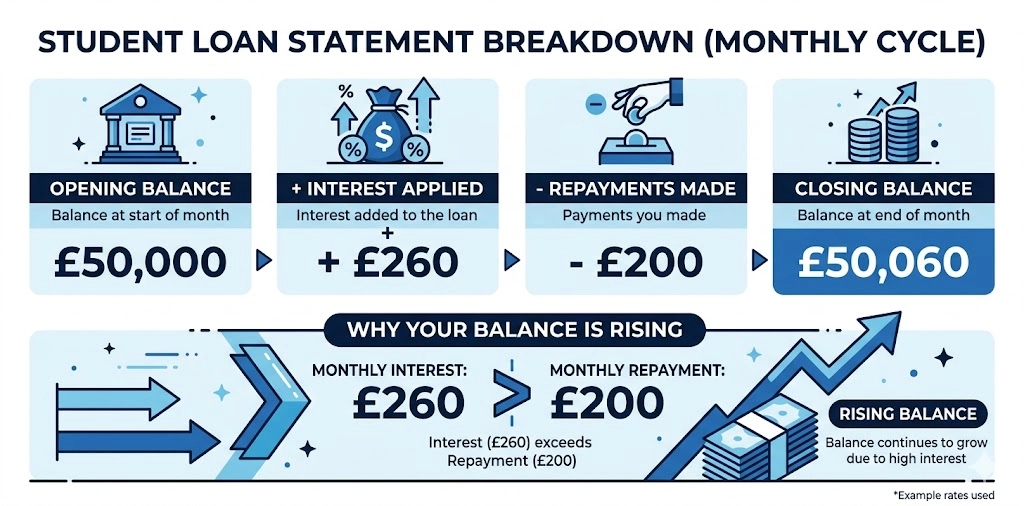
Why Your Student Loan Balance Keeps Growing
Most people expect their loan balance to shrink the moment they start repaying. For a lot of borrowers, particularly those on Plan 2, that does not happen straight away. Sometimes it does not happen for years.
The reason is straightforward. Interest is charged on your balance every single month, including while you are still at university. It does not wait until you graduate. It does not pause while your income is low. It runs from the date of your first loan payment, and it keeps running until your balance hits zero or the loan gets written off.
If the interest added to your balance each month is bigger than the repayment you make, your balance grows. That is not a sign that anything has gone wrong. It is just maths.
A graduate on Plan 2 earning £32,000 a year currently pays back about £23 per month, while 6.2% annual interest on a £50,000 balance adds roughly £258 per month. The gap closes as your salary rises, but in the early years after graduation, many borrowers are running uphill.
The important thing to understand is this: the interest rate does not change how much you repay each month. Your monthly repayment is set entirely by your income and your plan’s threshold. The interest rate only changes the size of your total balance. And for borrowers whose loans will get written off before they clear the balance anyway, the interest rate has almost no real impact on their finances at all.
To estimate your monthly deductions and visualize your long-term payoff schedule, visit the main Student Loan Repayment Calculator homepage.
The 2026/27 Student Loan Numbers You Need First
How your loan behaves depends entirely on your plan. For the 2026/27 tax year:
Repayment Thresholds and Rates
- Plan 1 (pre-2012 starters): repay 9% of income above £26,900
- Plan 2 (started 2012–2023, England & Wales): 9% above £29,385
- Plan 4 (Scotland): 9% above £33,795
- Plan 5 (started August 2023 onwards, England): 9% above £25,000 with first-ever repayments beginning April 2026
- Postgraduate Loan: 6% above £21,000 (on top of any undergraduate plan)
Interest Rates in 2026/27
- Plan 1 and Plan 4: the lower of RPI or Bank of England base rate + 1% currently the cheapest plans, around the 4% mark
- Plan 2: RPI up to RPI + 3% on a sliding income scale (the +3% applying fully above £52,885) but capped at 6% for 2026/27 under the government’s announcement this April
- Plan 5: RPI only, no added percentage
- Postgraduate: RPI + 3%, also capped at 6% this year
The Write-Off Dates (The Whole Game)
- Plan 1: written off 25 years after you became liable
- Plan 2: written off after 30 years
- Plan 4: written off after 30 years
- Plan 5: written off after 40 years
- Postgraduate: written off after 30 years
That write-off is why UK student loans behave less like debt and more like a graduate tax: you pay 9% of income above your threshold for a fixed period, and whatever’s left simply vanishes. Whether overpaying makes any sense at all hinges on one question would you have cleared the balance before the write-off anyway?
Before making any major financial decisions, ensure your figures are up to date by following our guide on how to check your student loan balance.
Why Overpaying Is Wasted Money for Most Plan 2 Borrowers
Here’s the uncomfortable arithmetic that loan overpayment guides skip. A Plan 2 borrower on £35,000 repays 9% of the £5,615 above the threshold about £42 a month. Against a typical £45,000+ balance accruing interest, that barely dents the loan; modelling across salary ranges consistently finds that most Plan 2 borrowers never repay in full before the 30-year write-off.
Now follow the logic through: if your balance is heading for write-off regardless, every pound you voluntarily overpay changes nothing about your future monthly payments (they’re set by income, not balance) and nothing about when the loan ends (the write-off date is fixed). The overpayment simply reduces a number that was going to be deleted anyway. You’ve gifted money to the Student Loans Company.
Two more facts sharpen this:
- Voluntary overpayments are not refundable. Once paid, there’s no undo even if your circumstances change.
- Repayments stop automatically if your income drops below the threshold. The loan flexes with your life; an overpayment doesn’t.
The only Plan 2 borrowers who should even consider overpaying are those on a clear path to full repayment well before their 30 years are up typically high and rising earners with smaller balances. For everyone else, “overpay the loan” is the intuitive answer and the wrong one.
Learn how PAYE deductions are automatically processed by your employer in our guide to employee student loan repayment.
What a Pension Contribution Actually Gets You
Against that, look at what happens to a pound that goes into your pension instead:
Tax Relief: An Instant Uplift
Pension contributions come from pre-tax income. For a basic-rate taxpayer, £100 in your pension costs £80 of take-home pay; for a higher-rate taxpayer, £60. That’s an immediate 25%–67% uplift before any investment growth a return no loan overpayment can match, and it applies within the £60,000 annual allowance most people never approach.
Employer Matching: Free Money
Many employers match contributions above the auto-enrolment minimum some match an extra 2–5% of salary if you contribute more. A matched pound is an instant 100% return. Nothing in personal finance beats it, and leaving match on the table to overpay a loan heading for write-off is the single most expensive version of this mistake.
Salary Sacrifice: The Double Win Against Student Loans
Here’s the interaction most articles miss. If your employer offers salary sacrifice, pension contributions reduce your gross salary and student loan repayments are calculated on that reduced salary. Sacrifice £200/month into your pension and your student loan repayment falls by £18/month (9% of £200), on top of the income tax and National Insurance you save.
Read that again: pension contributions via salary sacrifice actively reduce what you pay toward your student loan, while building your retirement pot. For borrowers heading for write-off, this is the closest thing the system has to a cheat code you redirect money from a loan that was never going to be repaid into an asset you keep.
The Trade-Off: Your Money Is Locked
Fairness requires the other side: pension money is inaccessible until at least age 57 (for those retiring from 2028), and investments can fall as well as rise. A loan overpayment, for the narrow group it suits, delivers a guaranteed “return” equal to the loan’s interest rate. Pensions win on maths for most people; they lose on flexibility for everyone.
Understand how inflation and RPI affect your balance over time by reading the UK student loan interest guide.
The Decision Framework: Work Through It in Order
- Employer match first, always. If contributing more unlocks matching you’re not claiming, do that before anything else 100% instant return.
- Ask the write-off question. Use a repayment calculator (like ours) to project whether you’d clear your loan before write-off on realistic salary growth. Heading for write-off → never overpay; treat the 9% as a tax and invest spare money elsewhere, with pension top of the list.
- If you would clear the loan, compare rates. Your loan’s interest rate (Plan 2: capped at 6% this year; Plan 1/4: ~4%; Plan 5: RPI) versus your expected long-run net pension return including tax relief. With relief, the pension’s effective return is hard to beat at basic rate and near-impossible at higher rate but a guaranteed 6% saved has genuine appeal for cautious high earners with short repayment horizons.
- Check the special zones. Earning £100,000–£125,140? Pension contributions restore your personal allowance, an effective 60% relief the pension wins outright. Near a threshold like £50,270? Contributions can keep you in a lower band. Have a Postgraduate loan stacking 6% on top? The combined 15% deduction strengthens the salary-sacrifice case further.
- Cover the basics first. Emergency fund (3–6 months) and any expensive debt (credit cards, overdrafts at 20%+) come before both pension top-ups and loan overpayments those interest rates dwarf everything in this article.
Navigating self-employment? Ensure you declare your income correctly with our Self Assessment student loan repayment tips.
Three Worked Examples (2026/27)
Maya repays about £35/month. At that pace, her balance grows or barely moves against capped 6% interest, and projections show write-off in year 30 with a large balance remaining. Overpaying £150/month would reduce a doomed number. The same £150 into her workplace pension costs her ~£120 net at basic rate, triggers her employer’s 2% extra match, and via salary sacrifice trims her loan repayment too. Verdict: pension, decisively.
Dan’s on the cheap legacy plan (~4% interest, 25-year write-off approaching, small balance he’ll clear naturally in about four years through PAYE alone). Overpaying saves him modest interest at 4% guaranteed; pension contributions at higher-rate relief give him a 67% uplift instantly. Verdict: pension first though clearing a small, nearly-dead loan for the psychological win costs him little either way. This is the “either is defensible” zone.
The genuinely hard case. Plan 5’s 40-year write-off means high earners like Priya will very likely repay in full possibly with decades of RPI interest on top. Overpaying genuinely shortens her repayment and saves real interest. But she’s also a higher-rate taxpayer where pension relief is at its most powerful, and salary sacrifice cuts her loan outgo now. Verdict: split approach is defensible max the match and higher-rate relief first, then direct genuine surplus at the loan. This is the profile where a proper adviser conversation earns its fee.
The Mistakes to Avoid, Whatever You Choose
- Overpaying a loan headed for write-off the flagship error this entire article exists to prevent.
- Skipping employer match for any reason.
- Forgetting overpayments are irreversible while pension contributions at least stay yours (locked, but yours).
- Comparing loan interest to pension returns without including tax relief the relief is the point.
- Deciding by debt-anxiety alone. The “debt-free feeling” is real and worth something but price it: for a write-off-bound Plan 2 borrower, that feeling can cost tens of thousands in forgone pension value.
Frequently Asked Questions
Should I overpay my Plan 2 student loan or pay into my pension?
For most Plan 2 borrowers, the pension projections consistently show the majority never repay in full before the 30-year write-off, which makes voluntary overpayments money spent on a balance that would have been cancelled anyway. Check your own trajectory with a repayment calculator before sending the SLC a penny extra.
Does paying into a pension reduce my student loan repayments?
Yes, if you use salary sacrifice: repayments are 9% of pay above your threshold, and sacrifice lowers that pay. Standard relief-at-source contributions from net pay don’t reduce PAYE loan deductions in the same way the mechanism matters, so check which type your employer runs.
Is it different for Plan 5 loans?
Meaningfully, yes. Plan 5’s 40-year write-off and RPI-only interest mean far more borrowers — especially higher earners will repay in full, so overpayment can genuinely save money. The pension’s tax relief still competes hard; for Plan 5 high earners it’s a real two-horse race rather than the Plan 2 walkover.
What are the student loan interest rates right now?
For 2026/27: Plan 1 and 4 around 4% (lower of RPI or base rate +1%); Plan 2 on a sliding scale capped at 6% this year; Plan 5 at RPI only; Postgraduate RPI +3%, also capped at 6%.
Are voluntary student loan overpayments refundable?
No. Once made, they cannot be reclaimed, even if you’d never have repaid the balance in full. That irreversibility is a core reason to run the write-off maths first.
Should I do this instead of clearing my credit card?
No expensive debt first. Credit cards and overdrafts at 20%+ outrank both pension top-ups and loan overpayments. The pension-vs-loan question is for money that’s genuinely spare after an emergency fund and costly debts.
Conclusion
For most UK graduates, putting extra money into a pension is usually better than overpaying a student loan, especially if you are on Plan 2 and are unlikely to clear the balance before the write-off date. Pension contributions can benefit from tax relief, employer matching, and salary sacrifice, while a voluntary loan overpayment cannot be recovered.
However, there is no single answer for everyone. Plan 5 borrowers and higher earners who are likely to repay their loan in full may find overpayments worthwhile. Start with your employer match, keep an emergency fund, clear expensive debt, and then compare your own loan repayment path with the benefits of pension contributions before deciding.

