
The Complete UK Student Loan Interest Guide 2026: Rates, Plans, Fees and Strategies
You made your payment last month. You checked your balance this month. It went up. That moment catches a lot of graduates off guard, and it is one of the most common reasons people start searching for answers about student loan interest rates.
You did nothing wrong. The system works in a way that most borrowers were never properly told about when they signed up. This guide covers everything you need to know about student loan interest in the UK for 2026, how rates are set, which plan you are on, what you are actually paying, and the mistakes that quietly cost borrowers money every year.
If you want to run your exact numbers, our student loan repayment calculator on this site gives you a personalised figure in seconds. But first, it helps to understand how the interest side of things actually works.
Why Your Student Loan Balance Keeps Growing
Most people expect their loan balance to shrink the moment they start repaying. For a lot of borrowers, particularly those on Plan 2, that does not happen straight away. Sometimes it does not happen for years.
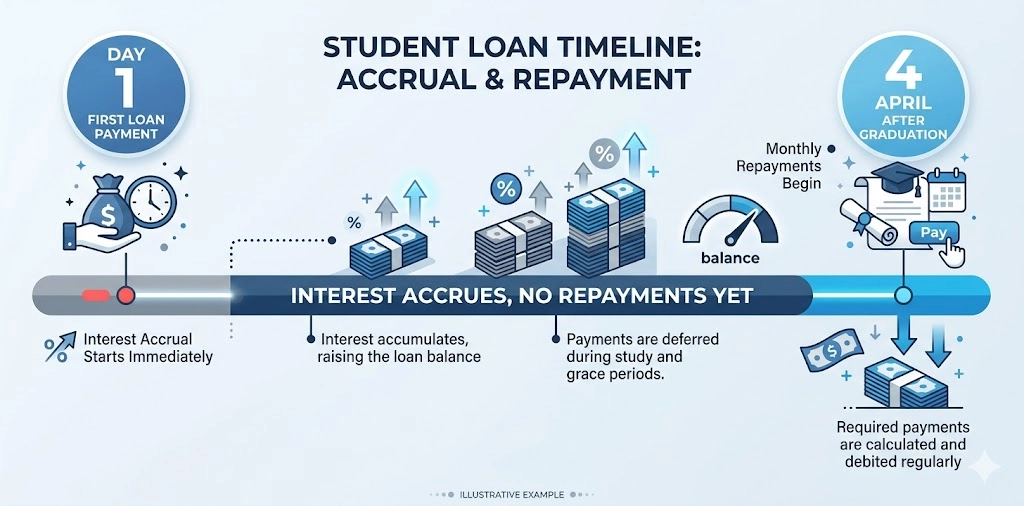
The reason is straightforward. Interest is charged on your balance every single month, including while you are still at university. It does not wait until you graduate. It does not pause while your income is low. It runs from the date of your first loan payment, and it keeps running until your balance hits zero or the loan gets written off.
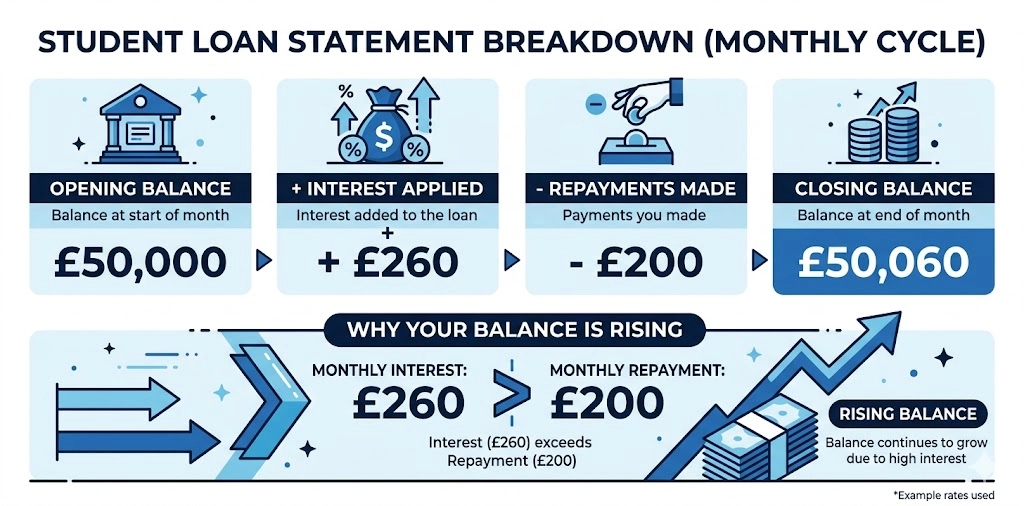
If the interest added to your balance each month is bigger than the repayment you make, your balance grows. That is not a sign that anything has gone wrong. It is just maths.
A graduate on Plan 2 earning £32,000 a year currently pays back about £23 per month, while 6.2% annual interest on a £50,000 balance adds roughly £258 per month. The gap closes as your salary rises, but in the early years after graduation, many borrowers are running uphill.
The important thing to understand is this: the interest rate does not change how much you repay each month. Your monthly repayment is set entirely by your income and your plan’s threshold. The interest rate only changes the size of your total balance. And for borrowers whose loans will get written off before they clear the balance anyway, the interest rate has almost no real impact on their finances at all.
Which Student Loan Plan Are You On and Why It Matters
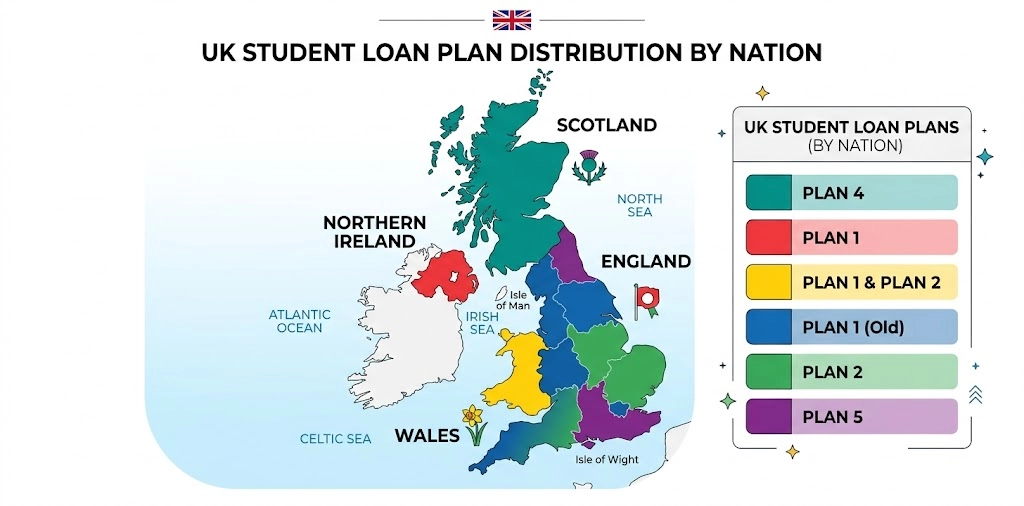
Your student loan plan determines your repayment threshold, your interest rate, and how long until your balance gets written off. These vary significantly between plans. Getting this wrong means you could end up applying the wrong strategies or misreading your statement entirely.
The plan you are on was decided by when you started your course and where in the UK you were living at the time. You cannot change it. What you can do is understand exactly how it works and make decisions based on accurate information rather than guesswork.
One thing that catches people out: someone who started their undergraduate degree in 2022 is on Plan 2, with interest rates up to 6.2% and a 30-year write-off. Someone who started two years later in 2024 is on Plan 5, with a flat 3.2% rate and a 40-year write-off. Same country, same university, completely different loan terms. The write-off timeline is longer on Plan 5, which is part of the trade-off.
For borrowers holding a postgraduate loan alongside an undergraduate loan, both repayments run at the same time once your income crosses both thresholds.
Plan | Who It Covers | Annual Threshold | Interest Rate | Write-Off Period |
Plan 1 | England/Wales Aug 1998–Aug 2012; all Northern Ireland borrowers | £26,900 | 3.2% | 25 years from April after graduation |
Plan 2 | England/Wales Sep 2012–Jul 2023 | £29,385 | 3.2%–6.2% (income dependent) | 30 years from April after graduation |
Plan 4 | All Scottish borrowers | £33,795 | 3.2% | 25–30 years (depends on start year) |
Plan 5 | England loans started in August 2023 onwards | £25,000 | 3.2% | 40 years from April after graduation |
Postgrad / Plan 3 | Master’s and doctoral loans, England and Wales | £21,000 | 6.2% | 30 years from April after leaving the course |
Student Loan Interest Rates UK 2026: The Full Breakdown
All rates shown here apply for the period September 2025 to August 2026. The base figure is the Retail Price Index from March 2025, which came in at 3.2%. Before planning any voluntary payments or major financial decisions, ensure you know your exact outstanding principal and accrued interest by learning how to check your student loan balance.
What RPI Actually Is and Why It Matters
RPI stands for Retail Price Index. It is a measure of how the cost of living in the UK changes over time. The rate used for student loans each September is based on the RPI figure from the previous March. In March 2025, that figure was 3.2%, so that is the base rate for 2025–2026.
The reason RPI matters beyond just knowing your interest rate is that it measures inflation slightly differently from other indices, and it tends to run higher than the actual change in most people’s cost of living by roughly one percentage point. So when the government says Plan 5 borrowers will not repay more than they borrowed in real terms, that claim depends on RPI being an accurate measure of inflation.
Plan 2 Interest: Why It Is Higher Than the Others
Plan 2 borrowers pay more interest than any other undergraduate plan because the structure was deliberately designed to make higher earners contribute more. After graduation, your Plan 2 interest rate slides from 3.2% at an income of £29,385 or under up to 6.2% at an income of £52,885 or above. The idea was that someone earning £60,000 should contribute more to the cost of their education than someone earning £30,000. This approach came from a higher education funding review in 2010 that redesigned the student finance system.
When Plan 5 was introduced in 2023, the sliding-scale interest was removed entirely. Plan 5 borrowers pay RPI only, currently 3.2%, regardless of their income. The trade-off is the longer write-off period of 40 years instead of 30.
Can the Rate Change During the Year?
For Plans 1 and 4, yes. Their rate is set as the lower of RPI or the Bank of England base rate plus 1%. Currently, the base rate sits at 3.75%, which means base rate plus 1% is 4.75%, above RPI at 3.2%, so the lower rate of 3.2% applies. If the base rate drops below 2.2%, the calculation would shift before the next September review.
For Plans 2, 3, and 5, the Department for Education monitors market rates every month. If the plan’s formula rate would exceed comparable commercial lending rates, the government caps it. This protection prevented Plan 2 borrowers from being charged 16.5% in 2023 when RPI briefly hit 13.5%. The rate was capped at 7.3% and gradually rose to 8% over the following year. Currently, with RPI at 3.2%, that cap is not active.
If you have fallen behind on manual payments or have unresolved issues with the Student Loans Company (SLC), read our guide on managing student loan arrears to restore your account to good standing.
Repayment Thresholds and How They Affect What You Pay
Your threshold is the income level at which you start making repayments. Below it, you pay nothing. Above it, you pay a percentage of the difference, not a percentage of your total income. For the 2026/27 tax year, the thresholds look like this:
Plan | Annual Threshold | Monthly Threshold | Weekly Threshold | Repayment Rate |
Plan 1 | £26,900 | £2,241 | £517 | 9% of income above the threshold |
Plan 2 | £29,385 | £2,448 | £565 | 9% of income above the threshold |
Plan 4 | £33,795 | £2,816 | £649 | 9% of income above the threshold |
Plan 5 | £25,000 | £2,083 | £480 | 9% of income above the threshold |
Postgrad (Plan 3) | £21,000 | £1,750 | £403 | 6% of income above the threshold |
To put this into real numbers: if you are on Plan 2 and earn £35,000 a year, you pay 9% of the difference between £35,000 and £29,385. That is 9% of £5,615, which works out at £505 per year or about £42 per month. Your £50,000-plus balance has no bearing on that figure.
For employed borrowers, repayments come out of your salary automatically through PAYE, the same way income tax and National Insurance do. You cannot miss a payment by accident, and you will not incur late fees. If your income drops below the threshold, the deductions stop automatically.
If you are self-employed, HMRC calculates your repayment through our self-assessment student loan guide based on your total annual income. Use our student loan repayment calculator to estimate what this could look like for your income level before your return is due.
This trips people up more than it should. Income for repayment purposes means your earnings before tax but after pension contributions. It includes:
- Salary and wages
- Bonuses and overtime
- Freelance and self-employment income
- Tips reported through payroll
It does not include ISA interest, money from savings accounts, or income shielded by tax-free allowances. Pension contributions made through salary sacrifice genuinely reduce your assessable income; this is a legitimate planning point worth discussing with a financial adviser if you are on Plan 2 and close to an interest rate threshold. If you are facing difficulty repaying your loan, read our guide to know other options you have.
Relocating outside the UK does not pause your debt obligations. Discover how your repayment thresholds are adjusted based on your destination country with our overseas student loan repayment guide.
Repaying More Than One Student Loan at the Same Time
If you hold more than one student loan, repayments work differently depending on which combination you have. For a detailed breakdown of repaying more than one loan, you can read our guide on this.
Two Undergraduate Loans
If you have Plan 1 and Plan 2 together, you pay 9% above whichever threshold is lower, that is, Plan 1 at £2,241 per month. There is a monthly cap on how much goes to Plan 1. The cap equals 9% of the difference between the two thresholds: 9% of (£2,448 minus £2,241) gives you a cap of around £18 per month for Plan 1. Anything above that cap goes to Plan 2.
Example: income of £3,200 per month. You pay 9% of (£3,200 minus £2,241), which is £86 per month total. Of that, £18 goes to Plan 1 and £68 goes to Plan 2.
An Undergraduate Loan, plus a Postgraduate Loan
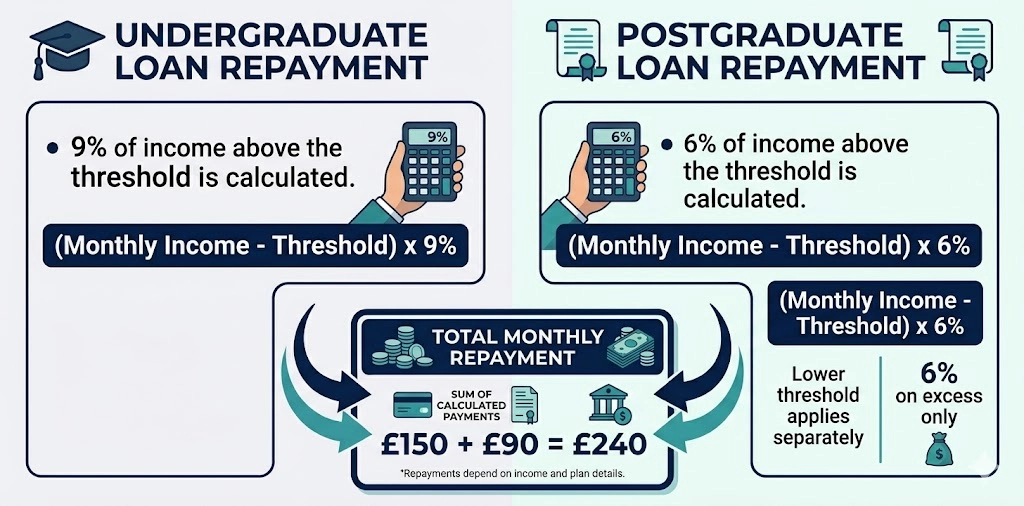
Both calculations run simultaneously. You pay 9% above your undergraduate threshold and 6% above the postgraduate threshold of £1,750 per month at the same time.
Example: Plan 2 plus a postgraduate loan, income of £2,500 per month. Postgraduate repayment: 6% of (£2,500 minus £1,750) = £45 per month. Plan 2 repayment: 9% of (£2,500 minus £2,448) = £4.68 per month. Total monthly repayment: roughly £49.
That total shows on your payslip as a combined deduction. If you notice your repayment seems higher than expected, the postgraduate loan element is likely the reason. You can check your loan balance separately through your online Student Loans Company account.
If you have borrowed under different systems for various degrees, understand how HMRC calculates your deductions when repaying more than one student loan.
A Note on Student Loan Fees
There are no arrangement fees, setup charges, or admin fees on UK student loans. The word ‘fees’ in terms like student finance, tuition fee loan refers to the product, the loan taken out to cover your tuition costs, not a charge on top of your borrowing.
Your student finance package likely included two parts: a tuition fee loan covering your course costs, and a maintenance loan covering living costs. Both of these sit together as one combined balance in your account and accrue interest at the same rate under the same plan. You do not repay them separately. The split between the two on your original paperwork is not something you need to track after graduation; it is all one balance.
Strategies to Handle Your Student Loan Interest in 2026
These are not vague suggestions. They are specific to how the UK student loan system works.
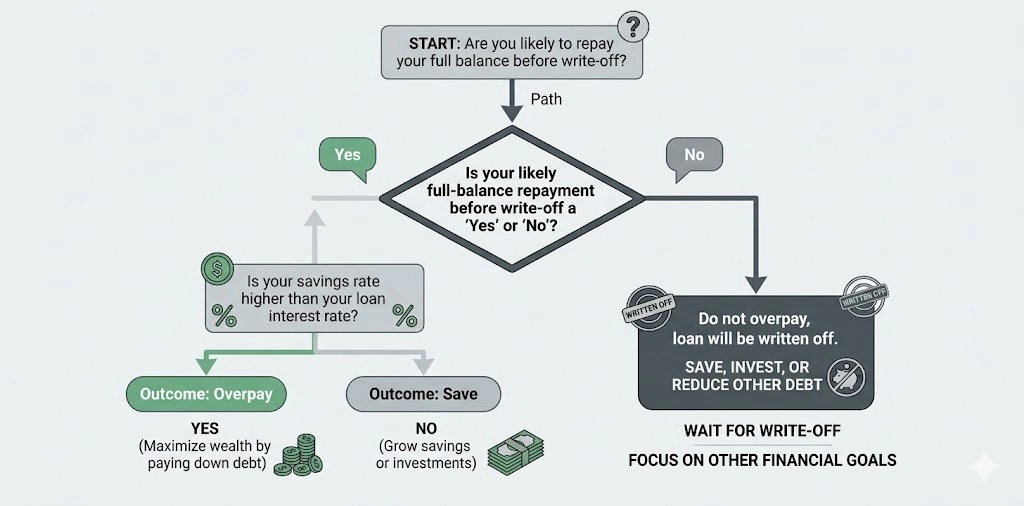
If your loan will be written off before you clear the balance, then the interest rate is largely irrelevant to your actual finances. You will repay 9% of your income above the threshold for however many years until the clock runs out, and then the balance disappears.
The government estimates that around 56% of full-time undergraduates from England who started in 2024/25, on Plan 5, will repay their loan in full. For Plan 2 borrowers from the 2022/23 cohort, that figure drops to 27%. If you are in the 73% of Plan 2 borrowers who will likely not repay in full, making voluntary overpayments does not save you money.
If your plan’s interest rate is 3.2% and you can find a savings account, cash ISA, or fixed-rate bond offering 4% or more, then every pound you put into savings instead of overpaying your loan earns you more money.
For Plan 2 borrowers earning above £52,885 who are charged 6.2% interest and who expect to repay their loan in full, the calculation shifts the other way. At 6.2%, you would need a savings rate above that to come out ahead.
If bonuses, overtime, or a period of low earnings meant your monthly income crossed the threshold in some months but your annual income stayed below the yearly threshold, you overpaid. That money comes back. You contact the Student Loans Company and request it.
If you are on Plan 2 and earning close to £29,385 or approaching £52,885, small changes in your assessable income can shift your interest rate band. Pension contributions made through salary sacrifice reduce your assessable income. If you sit just above the £29,385 lower threshold and pay RPI plus a small percentage, a modest increase in pension contributions could bring you back to RPI only.
This one feels administrative, but it has a direct financial cost if you ignore it. If the Student Loans Company asks for your income information and you do not respond, they default your Plan 2 interest rate to RPI plus 3%, regardless of what you actually earn. That could mean paying 6.2% instead of 3.2% for the entire period you failed to respond. Keep your email address and home address current in your account.
Master’s and Doctoral funding operate under distinct rules. Explore the specific thresholds and concurrent deduction rates in our postgraduate loan repayment overview.
Mistakes Student Loan Borrowers Make
1. Overpaying When Your Loan Will Be Written Off Anyway
If the numbers show your loan will outlast your repayment window, every voluntary payment beyond what is automatically deducted is money gone. You cannot reclaim voluntary overpayments. Run your numbers before making any extra payments.
2. Thinking Interest Stopped at Graduation
It did not. Interest runs continuously from the first payment date. While you were studying at 6.2% on Plan 2 or 3.2% on Plans 1, 4, and 5, interest was building. After graduation, it keeps building. During any period you earn below the threshold, repayments pause, but interest continues.
3. Not Checking Your Annual Statement
Your annual statement shows your opening balance, total interest applied for the year, total repayments made, and your closing balance. People who ignore this miss overpayments, errors in their plan type, and early indicators of whether they are on track to clear the balance. You can access your statement through your online Student Loans Company account.
4. Not Telling the Student Loans Company About Moving Abroad
This is a contractual obligation under the terms and conditions of your loan. If you move overseas and continue earning, you still owe repayments based on overseas income thresholds set by the Student Loans Company. Failing to notify them that you have moved can lead to penalty charges added on top of your normal interest. For a detailed procedure, read our overseas student loan guide.
5. Assuming All Plans Work the Same Way
They do not. Plan 2 has a sliding interest rate based on income. Plan 5 has a flat rate. Plan 1 uses a mechanism tied to the Bank of England base rate. Plan 4 mirrors Plan 1 but with a higher threshold. Postgraduate loans run a separate calculation in parallel to your undergraduate loan. Reading general student loan advice without checking which plan it applies to leads to genuinely bad financial decisions.
Frequently Asked Questions
What is the current student loan interest rate in the UK?
Plans 1, 4, and 5 currently charge 3.2% for the period September 2025 to August 2026. Plan 2 charges between 3.2% and 6.2%, depending on your income and whether you are still studying. The postgraduate loan charges 6.2%. All rates are based on the March 2025 RPI of 3.2%.
Does the interest rate change how much I repay each month?
No. Your monthly repayment is determined entirely by your income and your plan’s threshold. The interest rate affects only your total outstanding balance.
What happens to the interest if I stop working?
Interest continues to accrue even if you stop working or earn below the repayment threshold. Repayments pause automatically when your income drops below the threshold, but the interest does not stop.
Can I reduce my student loan interest rate?
No. Rates are set by the government and linked to RPI. You cannot negotiate them. What you can influence is the speed of repayment.
What is the difference between the tuition fee loan and the maintenance loan?
The tuition fee loan covers your course costs, paid directly to your university. The maintenance loan covers living costs and goes to you. You repay them as one loan, not separately.
What happens to my student loan if I move abroad?
The loan follows you. You must notify the Student Loans Company when you move. You continue to repay based on your overseas income using country-specific thresholds set by the Student Loans Company.
How do I know if I have been overcharged on interest?
Check your annual statement in your online Student Loans Company account. Compare the interest rate applied against what your plan and income level should give you. Errors do happen, particularly when income information is not reported or updated.
I am struggling to keep up with repayments. What can I do?
If you are employed and your income is below the threshold, repayments stop automatically. If you are self-employed and struggling, contact the Student Loans Company directly to update your income information.
Is student loan interest the same as a regular bank loan?
Not at all. A commercial loan charges interest on a fixed repayment schedule regardless of your income. Student loan interest grows your balance, but does not change your monthly payment. You only repay when you earn enough to trigger repayments.

