
Student Loan Repayment Calculator UK: How Much Do You Owe Each Month?
You got your first proper payslip. You stared at it. The number at the bottom was smaller than you expected, and somewhere in the deductions column, there was a line that said “Student Loan.” You had a rough idea this was coming, but nobody actually told you how much it would be or why.
That is the problem most graduates run into. The loan is taken out at 18, forgotten for a few years while you study, and then suddenly it starts coming out of your salary before you have had a chance to plan for it. You are not bad with money. You just were not given a clear picture.

Our student loan repayment calculator gives you that picture. Put in your income and your plan type, and you get your exact monthly deduction. No surprises on the next payslip.
This guide explains everything behind those numbers, including which plan you are on, how interest actually builds up in 2026, what happens when your salary goes up, and whether paying extra ever makes sense.
Student Loan Calculator
Estimate your UK student loan deductions and full repayment timeline
Your Repayment Breakdown
Monthly Deduction (Year 1)
£0
Annual Deduction (Year 1)
£0
Total Lifetime Repaid
£0
Amount Written Off
£0
Yearly Repayment vs Remaining Balance
What Is a Student Loan Repayment Calculator?
A student loan repayment calculator is a tool that works out how much comes out of your monthly pay based on your income and your loan plan type.
It is not your balance
Your monthly repayment has nothing to do with how much you borrowed. Nothing at all. It does not matter whether your total loan balance is £20,000 or £60,000. What matters is how much you earn above a set income threshold.
It is your income
That threshold changes depending on which plan you are on. Cross it, and you pay a fixed percentage of the income above it. Stay under it, and you pay nothing that month.
A figure you can budget
The calculator takes that logic and applies it to your actual numbers. You get a monthly figure you can actually budget around, not a vague estimate based on someone else's salary.
How to Use the Student Loan Repayment Calculator
Using the calculator takes under two minutes.
Enter your annual or monthly salary before tax and deductions
Select your loan plan from the dropdown (Plan 1, 2, 4, 5 or Postgraduate)
Add your loan balance if you want a long-term repayment projection
View your results: monthly deduction, annual total, and how long repayment could take
That is it. The calculator handles the maths automatically using the current 2026/27 thresholds set by HMRC.
If you are unsure which plan you are on, check your payslip, your annual loan statement, or log in to your Student Loans Company online account. Your plan type is listed there clearly.
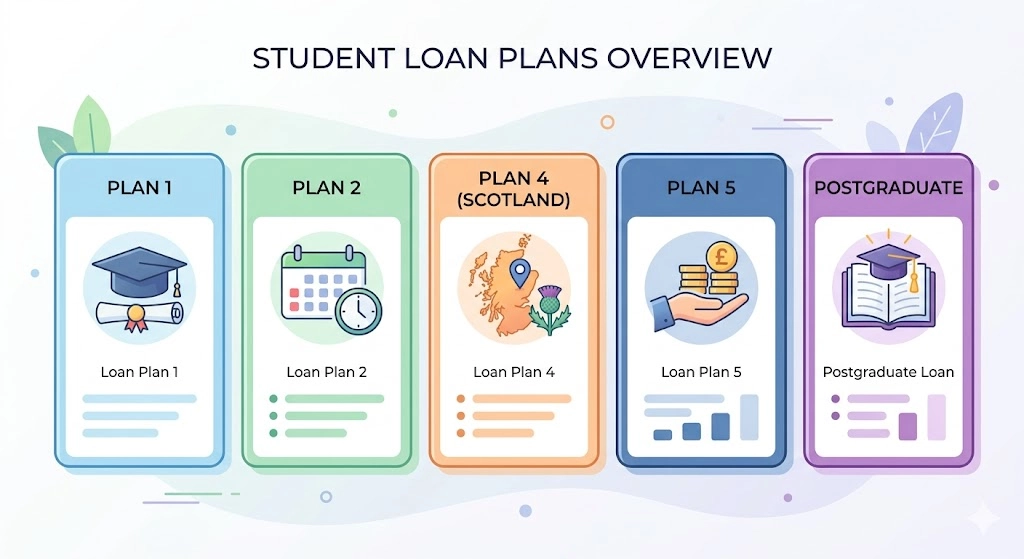
Which Student Loan Plan Are You On?
Your plan type decides your repayment threshold, your interest rate, and how long before the debt gets written off. These are not minor differences. They can mean hundreds of pounds a year and decades of repayment time.
Pre-September 2012
If you started your undergraduate course before September 2012, you are on Plan 1. This applies to most people who studied in England, Wales, or Northern Ireland during that period.
2026/27 thresholds:
- Annual: £26,900
- Monthly: £2,241
- Weekly: £517
You repay 9% of income above the threshold. The interest rate is a flat 3.2% in 2026/27. Your loan gets written off after 25 years from when you first became liable to repay, or when you turn 65, whichever comes first.
Example: You earn £33,000 a year (£2,750/month). Subtract the monthly threshold of £2,241. That leaves £509. Nine percent of £509 is £45.81. So you repay roughly £45 per month.
If you have questions about how interest builds on your balance, our student loan interest and fees guide breaks it down properly.
September 2012 to July 2023
This is the plan most current graduates are on. If you started a full-time undergraduate degree in England or Wales between September 2012 and July 2023, Plan 2 applies to you.
2026/27 thresholds:
- Annual: £29,385
- Monthly: £2,448
- Weekly: £565
Repayment rate is 9% above the threshold. Interest works differently here.
- Earn under £29,385: interest at 3.2%
- Earn between £29,385 and £52,884: interest slides from 3.2% up to 6.2%
- Earn over £52,884: interest at 6.2%
While you are still studying, interest runs at RPI plus 3%, which currently sits at 6.2%.
The write-off period is 30 years from the April after you finish your course. So if you graduated in 2024, the clock started in April 2025.
Scotland (from September 1998)
Scottish students who took out loans through the Student Awards Agency Scotland fall under Plan 4. If you had a Plan 1 loan through SAAS, it was automatically transferred to Plan 4 in April 2021.
2026/27 thresholds:
- Annual: £33,795
- Monthly: £2,816
- Weekly: £649
This is the highest threshold of any plan, meaning Scottish graduates keep more of their salary before repayments kick in. The interest rate is 3.2% and the write-off period is 30 years from when you became liable, or at age 65.
September 2023 Onwards
Plan 5 covers anyone who started their undergraduate course from September 2023 onwards. This is the newest plan, and repayments only began for these borrowers in April 2026.
2026/27 thresholds:
- Annual: £25,000
- Monthly: £2,083
- Weekly: £480
Repayment rate: 9% above threshold. Interest rate: 3.2%.
The write-off period here is 40 years. That is a decade longer than Plan 2. Graduates who started university in 2023 could be repaying into the 2060s if they remain on lower incomes.
Master's or Doctoral
If you took out a postgraduate master’s or doctoral loan in England or Wales, this is separate from your undergraduate loan and calculated differently.
2026/27 thresholds:
- Annual: £21,000
- Monthly: £1,750
- Weekly: £403
The repayment rate is 6% of income above the threshold, not 9%. The interest rate is 6.2%. Write-off period is 30 years.
Note that Northern Ireland treats postgraduate loans as Plan 1. Scotland treats them as Plan 4 from April 2021.
For more details on how postgraduate repayments work alongside undergraduate ones, visit our postgraduate loan guide.
Plan Comparison Table
Plan | Who It Covers | Annual Threshold | Monthly Threshold | Repayment Rate | Interest Rate | Write-Off |
Plan 1 | Pre-Sept 2012 (England, Wales, NI) | £26,900 | £2,241 | 9% | 3.2% | 25 yrs/age 65 |
Plan 2 | Sept 2012 to July 2023 | £29,385 | £2,448 | 9% | 3.2%–6.2% variable | 30 yrs |
Plan 4 | Scotland (Sept 1998+) | £33,795 | £2,816 | 9% | 3.2% | 30 yrs/age 65 |
Plan 5 | Sept 2023+ | £25,000 | £2,083 | 9% | 3.2% | 40 yrs |
Postgraduate | Postgrad England/Wales | £21,000 | £1,750 | 6% | 6.2% | 30 yrs |
Benefits of Using the Student Loan Calculator
Grinding through the years with a student loan often feels like a heavy weight. Most graduates simply guess what they owe each month. This guesswork creates unnecessary stress and makes budgeting almost impossible. Using a student loan repayment calculator changes that by giving you the actual facts.
Precise Monthly Totals
You see the exact amount leaving your paycheck based on the 2026/27 income thresholds.
Reliable Budgeting
It provides a clear annual figure so you can plan your yearly spending with total confidence.
Long-Term Vision
The tool creates a projection of your entire repayment journey based on your current salary.
Scenario Testing
You can see how a new job, a pay rise, or extra payments change your debt timeline.
Verified Data
The calculator uses official HMRC data rather than outdated or estimated figures from random sources.
Reduced Anxiety
Seeing real numbers often proves the debt is more manageable than the scary version in your head.
Smart Career Moves
You can compare different salary offers to see exactly how they impact your take-home pay.
Informed Decisions
It helps you decide if making extra payments will actually save you money before the loan expires.
How Your Repayments Are Taken
For most employed people, student loan repayments come out through PAYE. Your employer deducts them automatically from your gross pay every time you are paid, before you see the money.
PAYE (most employed people)
Your employer deducts based on information passed to them from HMRC. You do not have to do anything once you have given your employer the correct plan type on your starter checklist or handed over your P45 from your previous job.
If your employer has the wrong plan information, say they are deducting at the wrong threshold, that is worth fixing quickly because overcollected amounts need to be reclaimed through HMRC, which takes time.
Self Assessment (self-employed or those with other income)
HMRC calculates your repayment based on your annual tax return. This uses your full-year income figure, not monthly amounts. The repayment is collected alongside your tax bill in January, which is why self-employed borrowers need to budget for it across the year rather than treating January as a surprise.
Direct payments to the Student Loans Company
Used in specific situations: when you move overseas, when you are approaching full repayment and want to avoid overpaying through PAYE, or when you want to make voluntary additional payments on top of your regular deductions.
When you start a new job, declaring your plan type correctly matters more than most people realise. If you do not declare it, your employer may deduct under an emergency rate or not at all. Using a starter checklist rather than just assuming HMRC will sort it out is the right approach. For a full explanation of how employer deductions work, our employee student loan repayment page covers the process step by step.
Important point on voluntary payments: if you make payments directly to the SLC, that does not pause or reduce what comes out through PAYE. Both continue independently. Voluntary payments reduce your balance faster, but your employer carries on deducting the regular monthly amount regardless. Our terms and conditions guide explains how this works in more detail.
Repaying More Than One Student Loan at the Same Time
This is where it gets genuinely confusing. And most information out there does not explain it properly.
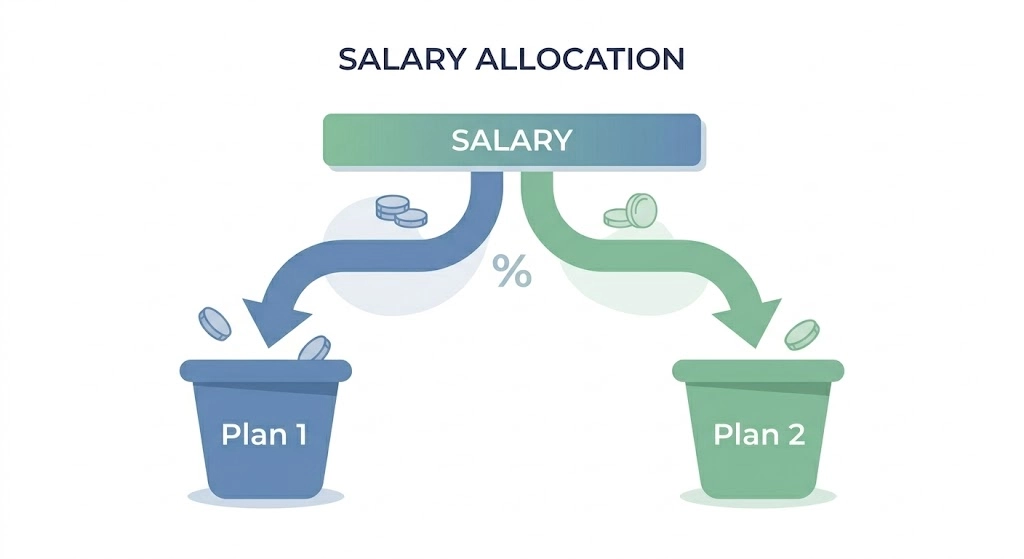
Two Plans Without a Postgraduate Loan
If you have loans under two different plans, say Plan 1 and Plan 2, you do not pay two separate percentages. You pay 9% of income above the lowest threshold of the two plans you hold.
But there is a cap on how much of that repayment goes toward the lower-threshold plan.
Example: You are on Plan 1 and Plan 2. Your monthly income is £3,200.
- Both the Plan 1 threshold (£2,241) and the Plan 2 threshold (£2,448) are exceeded
- You repay 9% of income above £2,241 (the lower threshold)
- That gives you: £3,200 minus £2,241 = £959. Nine percent of £959 = £86.31
- But Plan 1 has a monthly cap: 9% of the difference between the two thresholds = 9% of £207 = £18.63
- So £18 goes toward Plan 1 and £68 goes toward Plan 2
You still only see one deduction on your payslip. The split happens behind the scenes.
For a full breakdown of how this affects your balance over time, see our guide on repaying more than one student loan.
With a Postgraduate Loan Added
If you have a postgraduate loan on top of an undergraduate plan, two separate calculations run at the same time.
- 6% of income above the postgraduate threshold (£1,750/month)
- 9% of income above the threshold for your undergraduate plan
Example: You have a Postgraduate Loan and a Plan 2 loan. Monthly income is £2,500.
- Postgraduate calculation: £2,500 minus £1,750 = £750. Six percent of £750 = £45
- Plan 2 calculation: £2,500 minus £2,448 = £52. Nine percent of £52 = £4.68
- Total monthly deduction: roughly £49
Both deductions are collected together, but they go to separate loan balances.
How Student Loan Interest Actually Works in 2026
Interest is the part of student loans that surprises people most. It runs every single day. Even when you are not working. Even when you are earning below the threshold and making no repayments.
Plan 2 is the one to watch. While you are studying, you are charged RPI plus 3%, currently 6.2%. After you graduate:
Under £29,385 income: 3.2%
Between £29,385 and £52,884: slides from 3.2% up to 6.2%
Over £52,884: 6.2%
Here is the real-world problem that creates. A Plan 2 graduate earning £30,000 a year sits just above the repayment threshold. Their monthly repayment might be around £41. But at 3.2% interest on a £45,000 balance, roughly £120 in interest accrues each month. The balance grows, not shrinks.
This is not a flaw in the system to panic about; it is a feature of income-contingent loans. The loan will still be written off after 30 years, regardless. But it does mean extra repayments may not be as effective as people think, unless you are a high earner on track to clear it.
For a detailed explanation of how interest builds across your repayment period, our student loan interest and fees guide has the full breakdown.
What Happens When Your Income Changes Mid-Year
Student loan repayments are assessed monthly, not just annually. So if your income goes up or down during the year, your repayment adjusts.
Bonus or overtime payment
If a bonus or overtime payment pushes you over your monthly threshold in a single month, a deduction is taken that month, even if your usual salary sits below the threshold. That is just how the monthly calculation works.
Annual refunds
The other side: if you overpay across the year and your annual income ends up below the yearly threshold, you can apply for a refund. This is useful for people with irregular earnings, seasonal workers, commission-based roles, or anyone whose income is lumpy across the year.
Employed + self-employed
For self-employed borrowers, HMRC works off your full-year income from the Self Assessment return. Monthly fluctuations do not matter; your annual profit figure is what drives the calculation.
If you are both employed and self-employed, repayments happen in two stages. PAYE takes deductions throughout the year, and then Self Assessment calculates your total annual repayment, credits whatever was already taken through PAYE, and collects any shortfall.
Two Jobs, One Loan: How Multiple Employers Affect Repayments?
Here is something a lot of people with side jobs or two part-time roles miss. Each employer looks only at what they pay you. They do not know about your other income. So repayments are triggered per employer, not on your combined salary.
You have a Plan 1 loan. Job A pays £1,000/month. Job B pays £800/month. Neither crosses the Plan 1 monthly threshold of £2,241. No deduction from either employer.
You have a Plan 2 loan. Job A pays £2,500/month. Job B pays £500/month. Only Job A’s salary exceeds the £2,448 threshold. Repayment is taken from Job A only, on the £52 above threshold. Job B makes no deduction.
This means if your two jobs individually sit below the threshold but combined would exceed it, you may underpay through the year. HMRC will catch this through Self Assessment if you complete a tax return. If you do not, you might get a bill later. If you are self-employed on top of being employed, HMRC combines your total income on your Self Assessment return and calculates it on that combined figure. Any PAYE already taken gets credited against it, so you are not double-charged.
Student Loan Repayment for the Self-Employed
Self-employed borrowers do not have the neat PAYE system that employed workers use. Repayments come through Self Assessment, which means the timeline is different and the risk of underpaying is real.
Here is how it works. HMRC calculates your student loan repayment when you file your annual tax return. It uses your total income for the tax year, not monthly figures. This means you might earn a lot in some months and nothing in others, but what matters is the annual total.
The challenge is that the repayment is then due in January with your Self Assessment tax bill. If you have not been setting money aside throughout the year, this can land as a significant unexpected payment.
Work out your likely annual profit early in the tax year
Calculate your estimated student loan repayment using the annual threshold for your plan
Set aside roughly 9% of your profit above the threshold each month in a separate account
Submit your Self Assessment on time to avoid late filing penalties on top of the loan repayment
If you are both employed and self-employed, remember that PAYE deductions are credited against your Self Assessment bill. You pay on the combined income, but not twice on the same earnings.
Should You Make Extra Repayments?
This question comes up constantly, and the honest answer is: it depends entirely on your income trajectory.
Extra repayments save you money when you are on course to clear the full loan before write-off. In that situation, every extra pound you pay reduces your balance, which reduces the interest building up, which shortens your repayment period.
High earners on Plan 1 or Plan 2 who are already repaying significant amounts monthly are the clearest candidates. If your salary is above £50,000 and rising, you are likely to clear a standard-sized loan well before the 25 or 30-year cutoff. Extra repayments here have a real financial return.
This is the more common situation than most people realise. If your income is moderate and your loan balance is large, you may never repay the full amount before write-off. Plan 2 has a 30-year write-off. Plan 5 has 40 years.
If you pay an extra £5,000 voluntarily and the remaining balance gets written off anyway in 2055, that £5,000 bought you nothing except the satisfaction of having paid it. The write-off is unconditional; it does not matter how much is left.
Before making voluntary overpayments, ask yourself honestly: based on my likely salary path, will I clear this loan in full? If the answer is probably not, that money is better used building an emergency fund, clearing higher-interest debt first, or investing in a pension.
Some people make voluntary payments directly to the Student Loans Company, thinking it replaces their PAYE deductions. It does not. Voluntary payments reduce your loan balance, but your employer still takes the regular monthly deduction through payroll.
You end up paying both. The extra money speeds up repayment but does not pause the automatic deduction. Make sure you understand this before committing to voluntary payments.
More detail on how direct payments interact with your repayment plan is in our terms and conditions guide.

How Salary Increases Affect Your Repayments Over Time
A pay rise feels good. But if you have a student loan, part of that raise goes straight to your repayment.
The maths is simple. For every £1,000 your annual salary increases above the threshold, your annual repayment goes up by £90 (9% of £1,000).
Going from £35,000 to £40,000 on Plan 2 increases your annual repayment by £450. Your monthly take-home still goes up by significantly more than that; the extra repayment does not wipe out the raise. But it is worth factoring in when you are doing the maths on a new job offer or a promotion.
The bigger picture matters more than the month-to-month figure. As your career progresses and your salary grows, your repayments increase proportionally.
Mid-range Earners
For mid-range earners on Plan 2 or Plan 5 with large balances, the trajectory is often reversed. Repayments are made for years while interest builds alongside them, the balance barely decreases, and eventually the write-off cancels whatever remains. A graduate earning £32,000 on Plan 2 with a £50,000 balance will likely see that balance written off in 2054 or 2055, having never cleared it in full, even after decades of regular payments.
Understanding your personal trajectory is important when deciding how to manage your finances around the loan. If you are on a fast-moving career path in a high-paying field, your repayment maths looks very different from someone in a stable mid-salary role. The student loan repayment calculator UK helps you model both situations honestly before making decisions about extra payments or financial priorities.
High Earners
High earners repay substantially more each year, which is why the write-off timeline matters less for them. They are on track to clear the loan before it is cancelled, so higher repayments mean faster debt reduction, not just more money gone.
What Happens to Your Loan If You Live Overseas
Moving abroad does not cancel your student loan. The repayment obligation follows you.
If you leave the UK for more than three months, you need to contact the Student Loans Company directly. You cannot repay through PAYE from overseas. You set up direct payments instead, and the SLC provides overseas income thresholds that vary by country.
Broadly speaking, the overseas thresholds aim to reflect comparable living costs in your country of residence. They are not the same as UK thresholds. Some countries have higher adjusted thresholds, some lower.
Not reporting your overseas income and simply stopping repayments is not a viable option. The SLC can chase unpaid balances, and interest continues to accrue regardless of where you live.
Our living overseas with student loan page covers which countries have adjusted thresholds and how to contact the SLC to set up international repayments.
Student Loan Repayment vs Pension Contributions
This is a comparison that does not come up enough in standard repayment guides, and it genuinely matters for financial planning.
Both student loan repayments and pension contributions are calculated on your gross pay. But they interact differently depending on how your pension is set up.
do not reduce the income used to calculate your student loan repayment. Your student loan deduction is based on gross pay before pension, not after.
So someone earning £35,000 who sacrifices £3,000 into a pension via salary sacrifice would have their student loan calculated on £32,000 instead.
Build a three to six-month emergency fund
Clear high-interest debt first (credit cards, personal loans)
Get the most out of your employer’s pension matching contribution
Then consider extra student loan repayments, if at all
ISA contributions and additional investing after that
The pension is almost always a better use of money than voluntary student loan overpayments. Employer matching is free money. Tax relief on pension contributions is real. Student loan interest, while it exists, is not the same financial emergency as consumer debt.
How to Check Your Student Loan Balance
Your live balance is available through your online Student Loans Company account. Log in, and you can see:
- Your opening balance for the year
- Repayments received from PAYE
- Interest added month by month
- Your current outstanding balance
The annual statement is normally available in your account by the end of August each year, covering the previous tax year.
Many people are surprised to find their balance has grown since graduation. This is common, particularly for Plan 2 graduates in the early years of their career, when interest can exceed monthly repayments. Seeing the number go up does not mean the system has failed; it just means the loan is behaving as designed for lower earners.
If you want to check your balance between statements, the online account updates more regularly than the annual statement and is the most reliable source. Our student loan balance check guide explains what each line on the statement means and how to read it accurately.
Your Rights and Responsibilities as a Borrower
Both sides of this matter, and most guides only cover one.
Your rights as a borrower:
- You are entitled to accurate annual statements showing interest applied and repayments made
- You can request a detailed breakdown of how your repayment was calculated
- If your employer has deducted the wrong amount, you can raise this with HMRC
- You can make voluntary overpayments at any time without penalty
- You can request to switch from PAYE to direct payments in certain circumstances (e.g., approaching full repayment)
Your responsibilities:
- Keep your contact details updated with the Student Loans Company, including any change of address
- If you move overseas, notify the SLC before you go
- If you are self-employed, report your income accurately and on time through Self Assessment
- If you start a new job, declare your loan plan correctly on the starter checklist or P45; incorrect information leads to wrong deductions
Employers also carry responsibilities. They are legally required to deduct the correct amount under PAYE once they have your plan information. If they deduct nothing when they should, or deduct the wrong amount, that is an HMRC compliance issue, not a personal debt to the SLC.
Difficulty Repaying? What Your Options Actually Are
The good news about student loans is that they are specifically designed not to cause financial hardship. That is the point of income-contingent repayment.
- If your income drops below your plan's threshold, your PAYE deduction stops automatically. You do not need to apply for a pause. You do not need to notify anyone. It just stops.
- What does not stop is interest. That keeps accumulating regardless of your income level or employment status.
- If you are self-employed and having a genuinely difficult year, there is a risk of underpaying through Self Assessment if your income is hard to predict. In that situation, it is worth contacting the Student Loans Company proactively rather than waiting for a bill.
- Student loans do not affect your credit score. They do not show on credit reports. You cannot be forced into bankruptcy over a student loan, and bailiffs cannot be sent for non-payment while you earn below the threshold.
If you are struggling to understand your repayments or believe deductions are being taken incorrectly, start with our difficulty repaying student loan page, which sets out the steps to take.

Final Thoughts: Know Your Numbers
Student loan repayment is not a crisis. For most graduates, it is a background deduction that adjusts with income, pauses when earnings drop, and eventually disappears, either through full repayment or write-off. The system is genuinely designed to be manageable.
What makes it stressful is not the repayment itself. It is not known. Not knowing how much comes out. Not knowing whether your balance is growing or shrinking. Not knowing whether making extra payments actually helps you or just costs you money you did not need to spend.
That is the gap the calculator fills. Put in your salary and your plan type, and you get a real number. Not an estimate. Not a range. A figure you can work with.
Frequently Asked Questions
How much student loan will I pay on 30k?
On a £30,000 salary, your monthly repayment varies significantly by plan type, ranging from just £4.68 on Plan 2 to £37.53 on Plan 5. While all plans charge 9% above the threshold, the lower thresholds on Plan 1 and Plan 5 result in much higher monthly deductions.
Does my student loan balance affect my monthly repayment amount?
No. The size of your outstanding balance has no impact on how much you repay each month. Your monthly repayment is calculated entirely from your income and your plan’s threshold.
What happens to my student loan if I never pay it off?
It gets written off. Each plan has a write-off date counted from when you first became liable to repay: Plan 1: 25 years, or age 65; Plan 2: 30 years, Plan 4: 30 years, or age 65, Plan 5: 40 years, Postgraduate: 30 years. Whatever balance remains at that point is cancelled. You do not owe it.
Can I check how much of my student loan I've repaid this year?
Yes. Log in to your Student Loans Company online account. Your annual statement, usually available by the end of August, shows every repayment received during the previous tax year.
What if I earn below the threshold one month but over it the next?
Repayments are calculated on a monthly basis. If you earn over the threshold in any given month, a deduction is taken that month. If the following month your income drops back below the threshold, no deduction is taken.
Is it worth paying off my student loan early?
Only if you are a high earner who will definitely repay the full balance before write-off. For most graduates, the loan is likely to be written off before it is fully repaid. Voluntarily overpaying in that scenario means spending money you did not actually need to spend.
What is the repayment threshold for 2026?
The 2026/27 thresholds, which apply from April 2026 to April 2027, are:
- Plan 1: £26,900 per year (£2,241/month)
- Plan 2: £29,385 per year (£2,448/month)
- Plan 4: £33,795 per year (£2,816/month)
- Plan 5: £25,000 per year (£2,083/month)
- Postgraduate Loan: £21,000 per year (£1,750/month)
How much student loan do I repay every month?
Use the calculator at the top of this page to get your specific figure in under two minutes. Put in your salary and your plan type, and it does the rest.